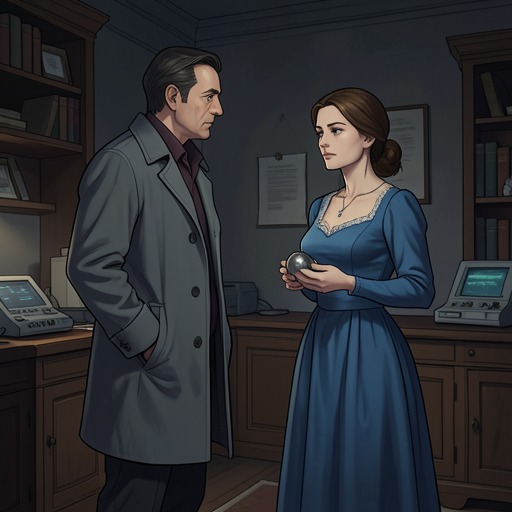
Andrew’s affair with Maggie and the breakdown of his marriage
The HumansThe Alien narrator’s affair with Margaret Lowell becomes a decisive test of his developing understanding of love: he can describe the encounter as pleasure, but his physical unease tells him that it conflicts with the attachment he feels to Isobel Martin, author of the unfinished novel. When he tells Isobel what happened, his attempt at candor does not repair their marriage. She demands a divorce, declares the relationship over, and orders him to leave the house. The rupture exposes how far his new capacity for feeling has carried him—and how little he yet understands the consequences of intimacy.
Background: a strained family
The marriage is already under pressure before the affair. Earlier, the Alien narrator sees Gulliver Martin walking alone along a street when he should be at school. Gulliver freezes on seeing him, then turns away. The encounter gives a visible shape to their distance: the father calls after his son, but Gulliver’s first response is to retreat.
That distance becomes more urgent when Gulliver is found on a roof in a suicidal crisis. The Alien narrator approaches him despite the wet slate and the difficulty of moving on human feet. He has begun to see Gulliver not as a collection of particles but as a person to whom he feels a difficult, unfamiliar connection. When Gulliver recalls swimming with him in France at the age of eight and learning dominoes together, the narrator answers as though he remembers. The memory gives their exchange a shared past, even as the narrator’s response conceals the limits of what he can genuinely recall.
Afterward, Gulliver tells his father that he has taken twenty-eight diazepam before going onto the roof. He also describes the pressure of being known as Andrew Martin’s son: teachers have read his father’s books and regard him through that association, while his own school history includes expulsion and setting things on fire. He remembers his father’s absence during holidays and the tension between his parents, and says they should have divorced years earlier. These disclosures establish a family already damaged by neglect and marital conflict; the later separation is not the beginning of that fracture.
The encounter with Margaret Lowell
The narrator learns that the woman he knows as Maggie is Margaret Lowell, his student. He regards her as unconventional, noting her self-description as Pythagorean, her experience teaching English in Spain, Tanzania, and parts of South America, and her work as a lap dancer to fund undergraduate study. Those details mark the contrast between her experience and his bewildered effort to interpret human relationships, but they do not prepare him for what the encounter means to him.
They have sex, yet the narrator experiences the intimacy as unlike the closeness he associates with Isobel. He distinguishes the physical encounter from the kind of kissing that, in his understanding, draws two people together. His account registers pleasure, but also discomfort and a sense of estrangement from the human body. The significant turn is not a sudden moral argument: almost as soon as they begin, he feels unwell and stops. He cannot fully explain the sensation, but recognizes that he does not want to continue toward orgasm. The encounter thus separates bodily pleasure from the emotional meaning he is only beginning to learn.
Confession and rupture
When the narrator returns home, Isobel is in the living room among her books, putting pens into a pot. Asked about his day, he tells her plainly that he has taught, met students, and had sex with Maggie. He senses that speaking is taking him into danger, but does not withdraw the disclosure. Isobel takes time to understand what he has said; then she drops a fountain pen, and the ink spills across the floor. The ordinary object becomes part of the scene’s sudden break in composure.
Isobel’s response moves from shock to anger and grief. She hyperventilates, throws the pen pot toward him, cries, and scratches his face when he approaches. The narrator tries to explain that he did not understand what he was doing, that the encounter was not an expression of love for Margaret, and that he had stopped when he recognized something was wrong. His explanation shows his incomplete grasp of infidelity: he compares the pleasure to food and struggles to understand why the act carries a significance beyond its immediate physical result. The comparison does not lessen the hurt or make the breach reversible.
When Isobel repeatedly asks who the other woman is, the narrator recognizes that he could lie or retreat from what he has admitted. Instead, he tells her that he does not love Margaret and does love her, while acknowledging that he understood something was wrong as the encounter was happening. His choice to tell the truth is not a successful act of reconciliation. It is a choice made inside a relationship whose trust has already been violated.
Separation and significance
The narrator tries to make Isobel understand that he is not from Earth, has never loved before, and has given up immortality and the inability to feel pain. She is not listening. She says she wants a divorce and blames him for destroying both their marriage and Gulliver’s life again. Her words connect the affair to the family’s older injuries, but the evidence does not make the encounter the sole cause of Gulliver’s crisis: his earlier account had already described his father’s absence and the tense household.
Newton appears, wagging his tail, but Isobel ignores him and starts to leave. The narrator holds her wrist and asks her to stay. She strikes him, then tells him that she wants him gone when she returns and out of their lives. She says she had believed he had changed and had let him back in. After she leaves, he remains in the house with Newton, recognizing that he has brought the relationship to a decisive end.
The episode makes the narrator’s emotional development consequential rather than abstract. His bodily unease interrupts the affair; his attachment to Isobel makes him confess; and his attempt at honesty cannot undo the harm. The marital breakdown also brings his new human limitations into the open: love is not merely a feeling he can name, but a bond shaped by trust, history, and actions whose consequences are not under his control.